The Best French Immersion Program in Paris for a Summer in French
Private French Lessons in Paris and Cultural Immersion in France
Every summer, I receive long messages from people preparing to come to Paris. Some are arriving for a few weeks before university. Some are taking a break from work. Some have been studying French for years and are slightly ashamed that they still hesitate so much when someone speaks quickly to them. Parents write about a son or daughter who understands grammar perfectly at school and yet remains almost silent in France.
Before they contact me, many of them have already searched for the best French immersion program in Paris, or private French lessons in Paris, or intensive French courses in France. But after a few exchanges, it usually becomes clear that they are not really looking for a programme in the traditional sense. They are looking for a way of crossing the strange distance between knowing a language and actually living inside it.
I have always been interested in the moment when French stops feeling external to someone. It does not happen in the way people imagine. It is rarely dramatic. More often, the shift arrives quietly. A student who spent twenty minutes hesitating over the past tense suddenly tells a story without stopping. A teenager who answered everything with one-word sentences begins speaking animatedly about a film or a piece of music while walking through Paris. Somebody laughs before translating the joke mentally. The language becomes quicker than the fear surrounding it.
Learn French in Paris Naturally
Research in neuroscience has only reinforced intuitions I already had as a teacher. The brain does not seem to retain language very deeply when words remain detached from lived experience. Memory changes once a sentence becomes attached to a place, a voice, a misunderstanding, a moment of embarrassment, or the pleasure of suddenly understanding something that would have seemed incomprehensible a few weeks earlier.
This is partly why French immersion in Paris can work so differently from classroom learning detached from everyday life.
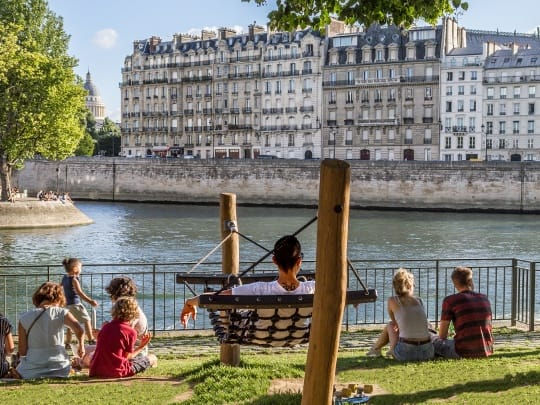
I began noticing it almost accidentally years ago. Students who struggled for an hour at a table would sometimes begin speaking much more naturally while walking through the city. Something shifted once their attention moved outward. They would stop monitoring themselves constantly and start reacting instead: to a street, a conversation overheard in a café, the description of a building, the atmosphere of a market on Sunday morning.
The language became less theoretical because it had attached itself to experience.
That is also why I have never liked teaching grammar as a sequence of abstract rules detached from actual speech. Grammar matters enormously, but I prefer working from the sentence the student is trying to build. A tense appears because the student suddenly needs it to tell a story properly. A correction matters because it changes the precision or rhythm of something they genuinely wanted to say. The rule arrives inside the attempt itself, which makes it far easier for the brain to retain.
Private French Lessons in Paris
This gradually became the basis for Bespoke French Lessons Paris.
I wanted private French lessons in Paris to feel intellectually serious without becoming rigid or academic in the lifeless sense. A person learning French before moving to France, a writer trying to regain fluency, a teenager spending the summer in Paris, a child hearing French daily for the first time, an adult who understands almost everything but still cannot answer easily in conversation: they cannot all be approached through the same structure.
Some students need conversation more than exercises. Others need precision because they already speak fluently but vaguely. Some need to rebuild confidence after years of believing they were “bad at languages”. Sometimes the work happens in a quiet café. Sometimes around a film or a book. Sometimes during a walk. Sometimes around one persistent grammatical habit that has been interrupting fluency for years.
The structure exists, but it follows the movement of the person rather than forcing the person to follow the structure.
French Immersion Program in Paris
Over time, Paris itself became part of the method !
We organise walks through the city with teachers who know Paris deeply, not only historically but emotionally. One may talk endlessly about old cinemas and the Left Bank in the seventies. Another notices tiny architectural details nobody else sees. Another knows which market still feels like a neighbourhood market at seven in the morning. These walks are not decorative cultural activities added onto French lessons in Paris. They change the texture of attention.
I began noticing that students often remembered French differently while moving through the city. A conversation outside a cinema near Odéon stayed in memory longer than a vocabulary list. Somebody who struggled to describe an image in a classroom could suddenly speak fluidly while trying to explain the colour of the sky above the Seine at the end of the day. The language stopped floating abstractly above experience and became tied to something physical and immediate.
Research on embodied cognition points in this direction too. Thought is not detached from the body as neatly as older theories once imagined. We remember differently while moving through space. We even speak differently.
Children enter French through rhythm, imitation and repetition long before they consciously analyse grammar. Teenagers often need the language to stop resembling school before they truly engage with it. Adults usually need something else altogether: enough precision to feel secure, but enough freedom to stop translating internally before every sentence.
What remains surprisingly constant is that language settles more deeply once it becomes attached to lived experience rather than performance alone.
Best Private French Lessons in Paris
When people ask me now what the best French immersion program in Paris is, I suspect the answer has less to do with intensity than with attention.
A person can spend entire days in a classroom and still remain oddly untouched by the language. Another may spend two concentrated hours in conversation, continue hearing French through the city afterwards, and realise a few weeks later that something fundamental has shifted.
French no longer feels entirely outside them.
Perhaps that is what I have been trying to build, quietly, with Bespoke French Lessons Paris: not a programme that asks students to leave themselves outside the language, but a way of helping French enter their real life.


Comments